
The First Time I Learned About the Wage Gap, I Was in a Garden
On unequal pay, inheritance, and how the dead refuse to become simple

The first time I learned that the world assigned different value to male and female labor, I was standing in a garden.
I was a child.
My brother and I had both been hired by my mother’s godmother, Helen Smith, to weed. We worked the same amount of time, around two hours. I am quite sure I did the better job. I was the more diligent one; I was more careful, more thorough, more likely to take a task seriously and to finish it properly.
When it came time to be paid, I received fifty cents. My brother received two dollars.
For the same work.
I never worked for her again.
At the time, I did not have any elegant language for what had happened. I did not know then how often inequality arrives in ordinary life wearing the clothes of common sense. I did not know how much of social order is transmitted through small transactions, unspoken assumptions, tiny humiliations, and the expectation that you will accept them quietly.
But I knew it was unfair.
I learned then that some invisible logic was already at work, arranging value before I had any say in the matter. And the fact that my parents did not contest the situation or remedy the inequality by paying me the difference taught me that this was not a one-off situation of one individual person acting upon their individual peculiarities. I remember my mother sympathizing with me, but doing nothing to change or alter the outcome. So I guess that I just accepted it as one of many lessons to come.
Years later, when I learned more formal language for gendered inequity, it did not feel like a revelation, so much as a confirmation. I had already met the concept. I had met it in a garden, in childhood, in my body, before I ever met it in theory.
And yet.
That is not the whole story of Helen Smith.
The older I get, the less interested I am in deciding whether people are fundamentally good or bad. That question is far too blunt for the actual texture of human life. Most people are not coherent enough to fit cleanly inside a verdict. They are warm in one setting and cold in another. Capable of generosity and care, and also pettiness, blindness, meanness, bias. They can injure one person while sheltering another. They can be deeply loved and quietly resented at the same time.
Helen was one of those people.
Because while I carried that silent grudge against her for years, I also knew (through my mother) that Helen had been caring, considerate, and genuinely good to her when she was young. My mother knew a different Helen than I did. Or perhaps not a different Helen exactly. Perhaps just another part of her.
That feels more truthful to me now.
When we are young, we tend to think that if we have seen something clearly, we have seen all of it. Age does not necessarily make us less perceptive. But ideally it makes us less simplistic. It teaches us that clarity is often partial. That one true thing is not always the whole truth. That people are far more than the story we think about them, even when the story itself may be accurate.
What I know of Helen comes in fragments.
A garden. My grudge. My mother’s affection for her. A few old photographs. And then, after her death around 1997, my inheritance of a large quantity of vintage slips and two handbags.
The slips especially became important to me, though not in the solemn way people usually speak about inheritance. They became part of my actual life. My late-90s teenage wardrobe was full of them — they were perfect under a cardigan, with Dr. Martens and black eyeliner. They had exactly the right balance of grunge, glamour and ghostliness. They felt intimate and elegant and slightly haunted, as good vintage often does. They belonged to another woman’s life and yet slipped, quite literally, into my own.
I love that now, the strangeness of it.
How a woman can wrong you in one register and still leave behind beauty that enters your becoming. How inheritance is not always moral clarity, and not even always sentiment. Sometimes it is texture. Actual fabric. An atmosphere passed hand to hand. A set of objects that outlive explanation and continue shaping the life of someone who never fully understood the person who owned them first.
Objects do this better than people, in a way.
But, perhaps not better. Maybe just more quietly. They carry traces without insisting on interpretation. They can preserve style, mood, aspiration, discipline, vanity, sensuality, domestic ritual. A slip can tell you something about how a woman wanted to move through the world. It can tell you about form and self-presentation, about what was worn close to the skin, about elegance as daily practice. But it cannot tell you whether she was lonely. It cannot tell you whether she knew she had been unfair. It cannot tell you whether she regretted anything at all.
Objects preserve. But they do not confess.
Photographs are similar.
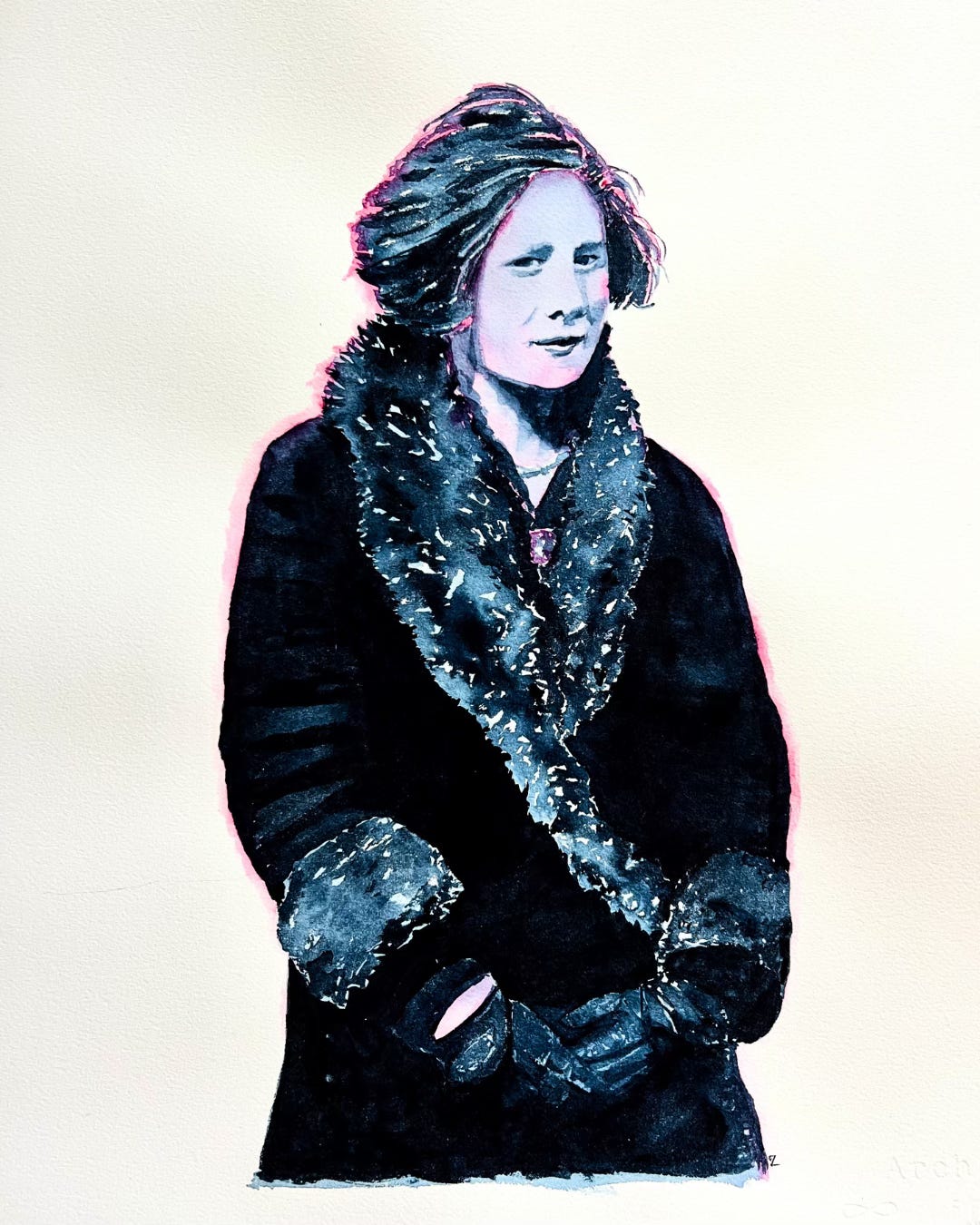
There are only a few lingering images of Helen that I have studied (my mother does have far more in albums), but one of has them stayed with me strongly enough that I painted her. In the photograph, she wears a fur coat. Her face is unreadable. Not hard. Not warm. Not happy. But maybe somewhat withheld. The kind of expression that makes you realize how little a face can be compelled to reveal. The more you look, the less it settles into certainty.
That seems right to me.
A face is not an explanation.
A photograph is not access.
Even memory, sincere as it may be, is not understanding.
It is only evidence that someone passed through the world in a certain form, under a certain light, leaving behind a mood, a style, a consequence, an impression. The rest remains mostly closed.
I guess that families are full of people like this: the figures who recur in stories, whose names remain in circulation, whose objects survive in drawers and closets, whose influence lingers, but whose inner life is mostly inaccessible. They remain in shards: an anecdote, a grievance, an admired trait, an old kindness, a strange silence, an inherited garment. We tend to assume closeness produces knowledge. But I think that actual knowledge is harder to come by.
The dead make this even more obvious.
When someone is alive, there is still the fantasy of clarification. You might ask the question one day. You might hear the story properly. You might say what offended you. They might explain themselves, however insufficiently. But death removes that possibility. What remains are the traces: the emotional afterimage, the objects, the stories that no longer have a final witness to correct them.
This is why the dead do not become simple. If anything, they become more complicated.
No new evidence arrives, only new interpretations. The living keep changing, and so the dead keep changing too — not in themselves, of course, but in relation to us. Apparently, our memories become just traces of themselves as they are recalled over and over, some sort of game of telephone occurring in our own minds, and continually changed by our own emotions, which evolve. A memory that once felt like a verdict begins to sit alongside other memories. A grievance remains, but so does beauty. So does tenderness. So does the unsettling fact that one person could contain all of it.
I still think what Helen did in that garden was unfair. I still think I was right to refuse to work for her again. But I no longer feel the need to make that the single final truth about her. Not because it did not matter. It did matter. Small injustices matter, especially when they arrive early and teach you something about the shape of the world. But people are rarely exhausted by the worst thing they did. They may not be redeemed by the best things, either. They remain stubbornly mixed, full of contradictions, blind spots, inherited assumptions, private injuries, unexamined habits, and unexpected generosities.
This may be one of the harder forms of maturity: learning not to confuse moral seriousness with simplification.
Not every contradiction can be resolved. Some can only be carried.
Helen, to me, is the woman who paid me less than my brother for the same labor. She is also the woman who cared for my mother. She is also the woman whose slips became a staple of my teenage wardrobe and helped shape some small part of how I moved through the world for many years (and I still wear many of her slips under dresses; they no longer function as outerwear for me, as they did when I was a teenager).
Helen is also the woman in fur, with the inscrutable face.
She is also, certainly, much more than any of these fragments can say.
Maybe that is one reason I paint.
Painting has never felt to me like a way of solving a person or a place. It feels more like a way of staying with what resists reduction. A face is never just a face. An object is never just an object. A landscape is never simply landscape. Everything visible carries more than it can say outright. History sits inside surfaces. Power hides inside ordinary arrangements. Beauty and harm coexist more often than we would like. Paint, at its best, lets you remain with that density, the solidness, a little longer.
The older I get, the more tender I feel toward complexity.
Life keeps showing me that truth is rarely thin.
And sometimes wisdom is nothing more glamorous than this: to admit that a person can wound you, shape you, leave something beautiful behind, and never become fully knowable at all.
LINGER
Such beauty you weave, Cole 🙏 Noting verbal connective tissue within linger - to lengthen, make long, remain in place, lingering & lingerie…